Driving a big boat is a different skill from driving a small runabout. A large vessel carries more weight, catches more wind and takes far longer to stop. This guide covers how to drive a big boat, with tips built for larger yachts, cruisers and motor vessels.
What Makes Driving a Big Boat Different?
On a small boat, you can correct a mistake quickly. On a large vessel, every input has a delayed result.
Here is what changes as boats get bigger:
- Heavy momentum. A big boat keeps moving long after you pull the throttle back.
- Longer stopping distance. Stopping can take several boat lengths, even at low speed.
- High windage. Tall hulls, flybridges and cabins act like a sail in a crosswind.
- Wide turning arcs. The stern swings out when you turn, so you must watch your back end.
- Limited visibility. A high helm and large cabin create blind spots near the dock.
The lesson is simple. Big boats reward early decisions and slow, smooth control.
Know Your Boat’s Controls
Many large vessels have more equipment than the average boat. Learn each system before you leave the dock.
- Twin engines. Shifting one engine forward and one in reverse turns the boat in tight spaces.
- Bow and stern thrusters. These push the bow or stern sideways for docking.
- Joystick controls. Some boats use one joystick to direct the engines and thrusters.
- Autopilot. This holds a heading but never replaces a watchful driver.
- Electronics. Radar, GPS, AIS and a depth sounder help you operate your boat safely.
Practice with each system in open water first.
Before You Leave the Dock
A big boat needs a thorough check every trip.
- Review the weather. Check wind, tides, current and sea state.
- Inspect the engines. Check oil, coolant, fuel and belts.
- Check safety gear. Confirm a life jacket for every person aboard, plus flares and fire extinguishers.
- Brief your crew. Assign line handlers and explain who does what.
- Use the kill switch lanyard if your boat has one. It shuts off the engine if the driver leaves the helm.
Large boats work best with a crew. Even a short trip is easier when two or three people share the work.
How to Start the Engine and Leave the Dock
Starting the engine correctly protects people and equipment.
- Run the blower on gas engines to clear fumes.
- Make sure the throttles are in neutral.
- Turn the key or press start, then let the engines warm up.
- Check gauges for oil pressure, temperature and charging.
- Have your crew release lines in the right order for wind and current.
Use short, gentle bursts of power to leave the dock. A large boat shifts its weight slowly, so patience prevents contact with pilings and neighboring vessels.
How to Steer a Big Boat
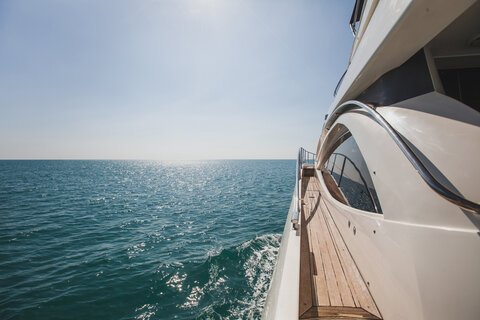
To steer a boat, turn the steering wheel toward your desired direction. On a large vessel, the response comes with a delay.
Keep these tips in mind:
- Make small, early corrections. Wait for the boat to respond before adding more input.
- Watch the stern. The back of the boat swings opposite to the turn.
- Use twin engines for tight turns. Opposite engine thrust spins the boat in its own length.
- Allow for wind and current. Both push a large hull harder than a small one.
Control Speed and Stopping Distance
A large boat has no brakes. Pull the throttle back early and gradually.
- Slow down well before docks, bridges and no-wake zones.
- Shift to neutral first, then use reverse in small bursts.
- Increase your distance from other vessels as speed rises.
- Expect longer stops with full fuel, water and passengers.
Smooth shifting also protects the transmissions.
Handle a Big Wave or Wake
A large wave hits differently on a big vessel. Weight helps stability, but a wave from the side can still cause a hard roll.
- Slow down before you reach the wave.
- Meet it bow first at a slight angle.
- Keep passengers seated and clear of the bow and swim platform.
- Secure loose items inside the cabin.
- Speed up gently once you pass it.
Docking a Big Boat
Docking is the hardest part of driving a big boat. Take it slowly.
- Approach at a shallow angle and use the lowest speed that keeps control.
- Stage fenders and lines before you arrive.
- Use thrusters and engine bursts to walk the boat in.
- Let the crew place spring lines to stop forward motion.
- Abort and try again if the approach feels wrong.
Licenses and Safety Courses
Most states do not require a separate license for recreational operators, but many states require a boating safety course. Rules vary by age, engine size and boat type. Operators who carry paying passengers typically need a captain’s license from the U.S. Coast Guard.
Check your state’s rules. A boating safety course or a hands-on lesson with a licensed captain is the best way to learn how to drive a big boat.
Ready to Take the Helm?
Driving a big boat comes down to planning ahead, moving smoothly and practicing often. Start in open water, build docking skills and consider hiring a captain for training.
Frequently Asked Questions
Q: What size boat counts as a big boat?
A: There is no official definition. Most boaters consider vessels over 40 feet to be large, and they often have twin engines, thrusters and enclosed helms.
Q: Is it hard to drive a big boat?
A: It takes practice, but it is manageable. The challenge is managing momentum, wind and tight spaces, not high speed.
Q: How do you stop a big boat?
A: Ease off the throttle early, shift to neutral and use reverse gently. Plan your stop well ahead, since large vessels glide many boat lengths.