Whether you're brand new to watersports or looking to sharpen your skills, understanding common wakeboarding and wakesurfing terms can make your time on the water more enjoyable—and safer.
This glossary breaks down essential terms you’ll hear behind the boat, at the dock, or at a cable park. It’s organized by category so you can quickly find what you need before your next session on the water.
Keep reading to learn more about must-know wakeboarding and wakesurfing terms!
Shared Watersports Terms (Wakeboarding & Wakesurfing)
These terms apply to both wakeboarding and wakesurfing. Familiarize yourself with them so that you can apply them to either sport.
1. Ballast
Additional weight added to a boat to create a larger, better-shaped wake. This can include built-in tanks, ballast bags, or passengers.
2. Boat Speed
The speed of the boat while pulling a rider. Wakeboarding is typically faster (about 18–24 mph), while wakesurfing is slower (about 10–12 mph).
3. Boat (Tow Boat)
The vessel that creates the wake and pulls (wakeboarding) or supports (wakesurfing) the rider.
4. Life Jacket / PFD / Vest
A personal flotation device required for safety. Always wear one when riding.
5. Rope
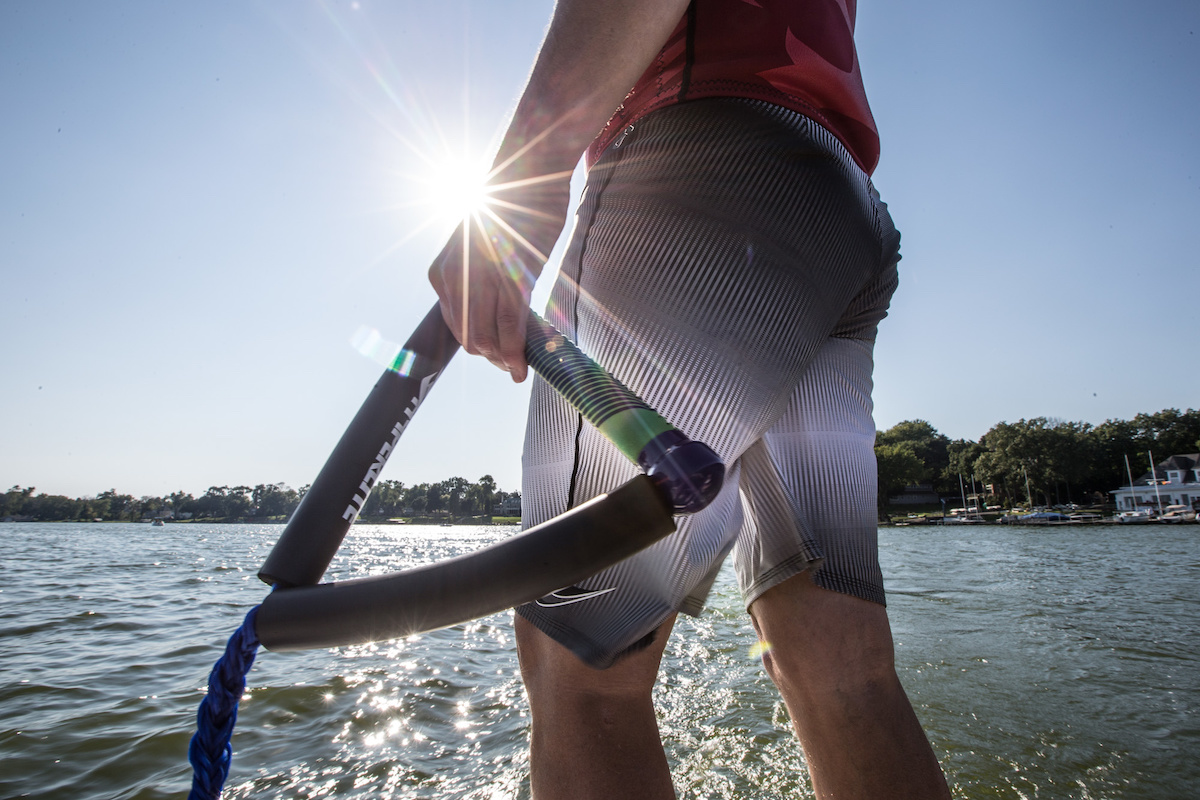
The tow line is used for wakeboarding or wakesurfing. Wakeboarding ropes are longer and low stretch; wakesurf ropes are shorter with a larger handle.
6. Wake
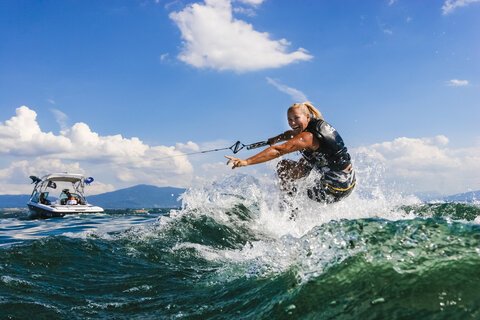
The wave created by a moving boat. Riders use it as a ramp (wakeboarding) or a surfable wave (wakesurfing).
7. Glass
Perfectly smooth water conditions with minimal wind or chop.
8. Choppy Water
Uneven, rough water that can make watersports more difficult.
9. Wipeout
A fall or crash during a ride.
Wakeboarding Terms
Wakeboarding involves being continuously towed by a rope while performing jumps, spins, and tricks. Keep reading to learn about must-know wakeboarding terminology.
Basics & Technique
10. Deep-Water Start
The standard method of starting a wakeboard ride from the water.
11. Heelside Edge / Toeside Edge
The two edges of the board used to carve and generate speed.
12. Edge
Using the board’s edge to create direction, speed, and tension in the rope.
13. Progressive Edge
Gradually increasing edge pressure as you approach the wake to generate more height and control.
14. Pop
The upward lift created when leaving the wake.
15. Switch
This pertains to foot positioning, specifically riding with your non-dominant foot forward.
16. Fakie
This is your opposite riding stance (often used interchangeably with switch).
17. Ollie
A trick where the rider lifts the board off the water without using the wake.
Air & Trick Terms
18. Air / Air Trick
Time spent airborne after leaving the wake or tensioning the rope.
19. Grab
Holding the board while airborne to add style and control. There are various types of grabs that can be performed.
20. Spin
A rotation in the air around a vertical axis (e.g., 180, 360).
21. Flip / Invert
Any trick where the rider goes upside down in the air.
22. Handle Pass
Passing the rope handle between hands during a spin or trick.
23. Revert
Landing riding in the opposite stance.
24. Wake to Wake
Jumping from one wake and landing on the other.
Style & Advanced Tricks
25. Backside / Frontside
Refers to the direction of rotation relative to the boat.
26. Raley
An advanced trick where the rider is extended horizontally behind the boat.
27. Mobe
A trick combining a flip and a spin.
28. Tweak
Styling a trick by extending legs or enhancing grabs.
29. Bone
Fully extending the legs during a grab for style.
30. Stomp
Landing a trick cleanly and controlled.
Boat & Equipment Terms
31. Ballast
Weight used to shape the wake.
32. Tower
An elevated tow point on the boat that improves airtime.
33. Pylon
A central tow point where the rope attaches.
34. Perfect Pass
A system that maintains consistent boat speed.
35. Rocker
The curvature of a wakeboard (continuous or three-stage).
Wakesurfing Terms
Wakesurfing begins with a tow rope, but riders release the rope and surf the boat’s wake freely.
36. Pocket
The most powerful part of the wave where riders generate speed and control.
37. Push
The natural forward energy of the wave that propels the rider without a rope.
38. Pump
Using body movement to generate speed while staying in the wave’s pocket.
39. Surf Rope
A shorter rope with a large handle used only to get up—not for riding.
40. Sweet Spot
The optimal position in the wake where the ride is smoothest and most powerful.
41. Skim Style / Surf Style
Two types of wakesurf boards: skim-style (loose, spins) and surf-style (carvy, stable).
42. Shuv / Shuvit
A wakesurf trick where the board spins 180 or 360 degrees under the rider.
43. Cable Park Terms (Wakeboarding Only)
These terms apply to wakeboarding at cable parks, not behind a boat.
44. Cable System
An overhead system that continuously pulls riders around a park.
45. Rail
A sliding obstacle made of metal, plastic, or composite material.
46. Slider
A longer feature used for boardslides and tricks.
47. Kicker
A ramp that launches riders into the air.
48. A-Frame
A rail feature shaped like an “A” used for advanced tricks.
49. Jib
Sliding or riding across obstacles instead of open water.
50. Dock Start
Starting a ride by launching directly from a dock instead of the water.
Safety & Control Terms
51. Bail
A controlled or accidental fall.
52. Stack / Digger
A hard crash or fall.
53. Loading the Line
Building tension in the rope before hitting the wake.
54. Standing Tall
Extending legs at the top of the wake to maximize pop.
55. Helmet
Protective gear often required at cable parks.
Frequently Asked Questions
Q: What’s the difference between wakeboarding and wakesurfing?
A: Wakeboarding keeps the rider attached to a tow rope for the entire ride, while wakesurfing allows the rider to release the rope and surf the boat’s wake.
Q: Do wakeboarding and wakesurfing require the same equipment?
A: They share similar boats and safety gear, but boards, ropes, and speeds are different.
Q: Why should you learn these terms before hitting the water?
A: Understanding the terminology improves safety, communication with the boat driver, and overall performance on the water.
Read Next: Plan a Summer Boating Bucket List
Ready to Try These Board Sports?
Learning the language of wakeboarding and wakesurfing builds confidence and helps riders improve their skill levels. Now that you know the terms, you’re ready to get out on the water, communicate clearly, and enjoy the ride.