A good duck hunting boat helps you reach birds quietly, carry your gear, handle changing weather, and set up safely before shooting light. The best boat depends on where you hunt, how many people are on board, and the conditions you expect to encounter.
What Makes a Boat Right for Duck Hunting?
The right duck hunting boat matches your water, hunting style, and typical load. A small marsh rig may be ideal for flooded grass, while a larger boat may be safer and more comfortable on windy lakes or wide rivers.
Duck hunting can mean launching before sunrise, navigating cold water and vegetation, carrying decoys and dogs, and beaching the boat on mud, sand, or gravel. Look for a boat that offers:
- Stability: A stable platform is important when setting decoys, handling a dog, or shifting weight.
- Shallow-water capability: Many productive hunting areas are marshes, backwaters, flooded timber, and other shallow waters.
- Durability: The hull should handle stumps, vegetation, ice, ramps, and rough shorelines.
- Capacity: Make sure it can safely carry hunters, dogs, decoys, blinds, fuel, firearms, and other gear.
- Concealment: A boat that can accommodate a blind, brush, or other camouflage can be useful in the field.
- Ease of operation: Simple layouts make launching, retrieving birds, and navigating in low visibility easier.
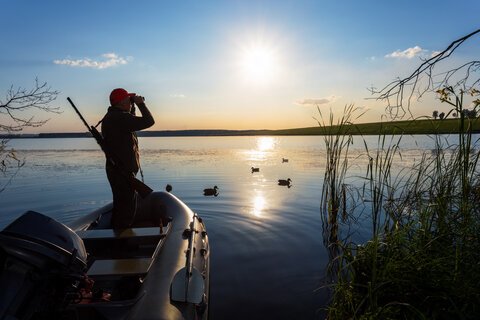
Common Types of Duck Hunting Boats
Different boat styles work better in different environments. Understanding the trade-offs can help you choose the right size and hull.
Jon Boats
Jon boats are a popular choice because they are simple, versatile, and practical. Their flat bottoms work well in shallow water, while open layouts provide space for decoys, dogs, and duck boat accessories. They can also be customized with seating, storage, flooring, lights, and blinds.
A jon boat can be a good choice for marshes, protected bays, and slow rivers. However, flat-bottom hulls can ride rougher in chop. If you regularly hunt larger lakes or open water, consider width, freeboard, and stability.
V-Hull and Modified V Boats
V-hull and modified V boats are better suited to rougher water. Their deeper hulls handle chop more comfortably, making them useful on larger rivers, reservoirs, and open water.
The tradeoff is draft. A deeper hull may not access extremely shallow areas as easily as a flat-bottom boat. A modified V can be a good compromise if you hunt both open water and shallow areas.
Skiffs and Marsh Boats
Skiffs and low-profile marsh boats are designed for access and concealment. They can navigate narrow channels, grass, and shallow areas where larger boats may be difficult to maneuver.
These boats work especially well for solo hunters or small groups with lighter loads. Limited space can become an issue if you carry several hunters, a dog, or a large decoy spread, so consider your full hunting load before choosing one.
Layout Boats
Layout boats are designed for low-profile open-water hunting. They keep the hunter close to the waterline, reducing visibility to approaching birds.
This is a specialized option best suited to hunters who understand their hunting environment and the additional safety considerations of exposed water. Support boats, weather awareness, and reliable communication are especially important.
Match the Boat to Your Hunting Environment
The best duck hunting boat is the one that fits the water you use most.
Marshes and shallow backwaters: Look for minimal draft, stability, and a layout that makes it easy to move around without catching gear. Jon boats, skiffs, and marsh-specific boats are common choices.
Rivers: Consider current, debris, ramps, and changing water levels. You may need enough motor power to safely navigate current and a durable hull for stumps and sandbars.
Lakes and open water: Stability and freeboard become more important. Wind can quickly create waves, and cold water leaves little room for mistakes. A wider boat with a capable hull may be worth the extra size.
Flooded timber: Maneuverability is key. A compact boat that can turn and move through tight spaces may be more useful than a larger boat with greater capacity.
How Much Space and Capacity Do You Need?
Choose a boat based on the total weight and space required for hunters, dogs, gear, and safe operation. Decoys, firearms, blind materials, batteries, fuel, anchors, and cold-weather clothing can add up quickly.
Start with your typical crew. Solo hunters may prefer a smaller, easier-to-launch boat, while groups should prioritize width, floor space, and storage.
Consider your normal load:
- Hunters and clothing: Waders, insulated jackets, and blind bags require extra space.
- Firearms and safety equipment: Keep these secure, dry, and accessible.
- Decoys and rigging: Even a modest spread can take up considerable room.
- Dog gear: Account for a dog platform, ladder, vest, and safe space for the dog.
- Blind materials: Grass mats, frames, brush, and fabric can add bulk.
- Power and fuel: Batteries, fuel tanks, and motor equipment need secure placement.
A well-organized layout matters as much as overall size. Loose gear creates trip hazards and makes it harder to react quickly when conditions change.
Read Next: Boat Capacity Requirements
Power Options Shape Performance
Motor choice affects how a hunting boat performs. Outboards are common for situations where you have adequate water depth and need to cover distance.
Mud motors are popular in shallow, weedy, or muddy environments where a traditional prop may struggle. They can provide access to difficult areas but require the right hull and setup.
Paddles, push poles, and electric motors can also be useful in smaller or restricted waters where quiet movement is more important than speed.
Before choosing your power, consider:
- How far you travel from the launch
- Whether the water is deep, shallow, muddy, weedy, or timber-filled
- Whether motor restrictions apply
- Whether you prioritize speed, quiet operation, or maneuverability
- Whether you can safely operate the boat alone
Choose the boat and motor as a system so the setup matches your hunting conditions.
Features That Make Hunting Easier
The right features can make a basic boat more comfortable, efficient, and safe. You do not need every upgrade, but a few practical additions can make a difference.
A flat, non-slip floor provides a safer surface when wearing waders and keeps gear from sliding around. Storage helps keep essentials dry and reduces clutter. Navigation lights and reliable handheld lights are also important because duck hunting often begins and ends in low light.
Concealment is another key consideration. A boat blind, natural brush, or camo finish can help break up the boat's outline.
Useful duck boat accessories include:
- Boat blind
- Grass mats, brush straps, or camo netting
- Non-slip flooring
- Decoy bags or storage
- Gun box or dry storage
- Dog ladder or platform
- Push pole or paddle
- Anchor system
- Bilge pump and backup drain plug
- Interior lighting
- Battery box and organized wiring
Choose accessories that solve real problems rather than filling the boat with unnecessary equipment.
Safety Should Guide Every Decision
Cold water, low light, firearms, dogs, and heavy gear make waterfowl hunting demanding. Safety should influence your boat size, motor, layout, and equipment.
Do not overload the boat, and distribute weight evenly before leaving the ramp. Keep life jackets accessible and suitable for cold-weather clothing. Store firearms safely during travel and avoid layouts that require people to step over gear.
Before heading out:
- Check the drain plug, fuel, battery, and motor.
- Carry required safety equipment and know where it is stored.
- Check weather, wind, and water conditions.
- Use navigation lights in low visibility.
- Keep a communication device protected from water.
- Tell someone where you are hunting and when you expect to return.
- Carry basic tools, spare rope, and emergency warmth.
- Practice loading and unloading with your normal hunting setup.
A stable, organized, manageable boat can make hunting safer as well as more enjoyable.
Budget for the Full Setup
The boat itself is only part of the cost. Consider the motor, trailer, blind, storage, lighting, registration, maintenance, and other duck hunting gear when setting your budget.
When buying used, inspect the hull, transom, trailer, wiring, and motor for damage, corrosion, leaks, poor repairs, and signs of neglected maintenance.
When buying new, consider whether you need every accessory immediately. Starting with the right hull and motor and adding equipment over time can help you stay within budget.
A Practical Way to Narrow Your Choice
When comparing duck hunting boats, focus on how you actually hunt. Consider where you hunted last season, how many people typically joined you, how much gear you carried, and what problems you encountered.
Use this process to narrow your options:
- Choose the water type you hunt most often.
- Determine your typical crew and gear load.
- Decide whether shallow access, rough-water handling, or concealment is most important.
- Choose a hull that matches those priorities.
- Select a motor that fits the boat and conditions.
- Plan storage, safety equipment, and blind setup.
- Consider the layout with a full hunting load.
Instead of choosing the biggest, fastest, or most customized boat, focus on the one that makes your hunts safer and easier.
Final Takeaway
Choosing the best duck hunting boat starts with your hunting environment and typical load. Focus on stability, capacity, shallow-water access, concealment, and safety before adding extras. Once you have the right hull and motor, the right accessories can make your setup more efficient and comfortable.
Q&A
Q: What is the best type of boat for duck hunting?
A: The best duck hunting boat depends on where you hunt. Jon boats are popular for shallow marshes and protected water, while V-hull and modified V boats are better suited to rougher open water. Skiffs and marsh boats can work well in tight, shallow areas, while layout boats are designed for specialized open-water hunting.
Q: What size boat is best for duck hunting?
A: The right boat size depends on the number of hunters, dogs, decoys, and gear you typically carry. Choose a boat with enough capacity to safely handle your full hunting load without being overcrowded or difficult to maneuver.
Q: Are mud motors good for duck hunting?
A: Mud motors can be a good choice for shallow, muddy, or weedy hunting areas where a traditional propeller may struggle. The motor should be matched to the boat hull and the conditions you expect to encounter.