A sailboat sails upwind by angling its sails like an airplane wing to create lift, then zig-zagging at roughly 45 degrees to the wind. This zig-zag is called tacking. A boat can’t sail straight into the wind, but it can work its way to any upwind destination. Keep reading to learn more about sailing upwind and how it works, plus tips to help you do it well.
How Can a Sailboat Sail Against the Wind?
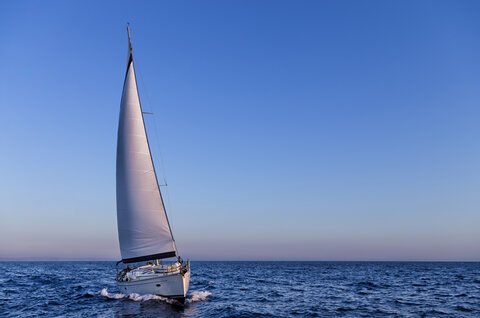
Sails don’t just catch wind. They work like wings. Unless the wind is directly behind the boat, the sails move it forward because of lift created when air flows across the curved sail. It’s the same principle that lifts an airplane.
Two things make this work:
- Lift from the sails: Air moving over the sail creates a forward pull.
- Resistance from the keel: The keel or centerboard stops the boat from sliding sideways, so the sail’s force pushes the boat ahead.
How Do Sails Generate Lift?
A sail is curved, and that curve is what generates lift. Wind blowing across the sail splits at the leading edge (the front edge of the sail). Air travels faster across the outer, curved side, lowering the pressure there and pulling the sail forward.
Every sail has two sides:
- Windward side: The side the wind hits first.
- Leeward side: The side facing away from the wind, where most of the pulling force is created.
Understanding the windward and leeward sides of a sail helps explain why trimming matters so much. The sail's shape determines how much lift it creates.
The keel’s role: Below the waterline, the keel or centerboard works the same way. Water flow across it resists sideways drift, so the sideways push from the sails turns into forward motion.
What Is Apparent Wind?
Apparent wind is the wind you feel while the boat is moving. It combines the true wind with the wind created by the boat’s own speed.
When sailing upwind, apparent wind is stronger than true wind and shifts closer to the bow. This is why boat sails can feel overpowered as the boat speeds up, and why upwind sailors constantly adjust their angle to the wind. Sails are trimmed to the apparent wind, not the true wind.
Read Next: Sailing Navigation Tips
What Is Close-Hauled Sailing?
Close-hauled is the point of sail closest to the wind. It’s how sailors make progress upwind.
- Modern sailboats can sail up to about 45 degrees off the wind.
- The sails are trimmed in tight to stay full and keep generating lift.
- The area directly into the wind, called the “no-go zone,” is where the sails stop producing lift.
Sail too close to the wind and the sail will luff. The forward edge flutters, the boat slows, and turning farther into the wind makes the whole sail flap like a bed sheet on a clothesline.
How Does Tacking Work?
Tacking is the zig-zag turn that moves a sailboat upwind. The boat turns through the wind so the sail fills on the opposite side.
- Sail close-hauled on one tack, about 45 degrees off the wind.
- Turn the bow through the wind. The sails will luff briefly.
- Fill the sails on the other side as the boat settles onto the new tack.
- Trim in and keep sailing close-hauled.
The boat now heads at about a right angle to its old course, with the wind still 45 degrees off the bow but on the opposite side. Repeat the process and the boat zig-zags upwind. Sailors call this “beating” or tacking to windward.
Port tack vs. starboard tack: The tack is named for the side the wind comes over. Wind over the port (left) side means port tack. Wind over the starboard (right) side means starboard tack.
How Does Sail Trim Affect Upwind Sailing?
Good sail trim is the biggest factor in upwind performance. When sailing close-hauled, the goal is to keep the sails full and the boat speed steady.
- Trim the jib sheet. This line controls the jib, the sail in front of the mast. Pull it in tight for close-hauled sailing and ease it as you bear away.
- Watch the leading edge. If it starts to flutter, the sail is luffing. Trim in or steer slightly away from the wind.
- Balance speed and angle. Pointing as close to the wind as possible isn’t always fastest. A slightly wider angle often builds more boat speed, and it can get you upwind faster.
Port Tack vs. Starboard Tack: Which Has Right of Way?
Tacks are named for the side the wind comes over. On port tack, the wind blows over the boat’s left side. On starboard tack, it blows over the right side.
In general, a boat on starboard tack has the right of way over a boat on port tack. Keep this in mind when tacking near other boats, since a boat that has just turned the boat through the wind must keep clear of traffic on its new course.
Common Mistakes When Sailing Close to the Wind
Sailing close to the wind is a balancing act. Beginners often make these errors:
- Pinching: Steering too close to the wind. The sails luff and the boat slows.
- Oversheeting: Trimming the sails too tight. This stalls airflow and reduces lift.
- Tacking too often: Every tack costs speed. Make each one count.
- Ignoring the wind: Gusts and shifts change the best angle. A boat that sails closer to the wind when a shift allows gains ground without extra tacks.
Tips for Sailing Upwind
Sailing upwind efficiently takes more skill and practice than almost anything else in sailing. These habits help:
- Trim the sails tight. Keep them full without over-tightening.
- Watch the luff. A fluttering forward edge means you’re pointing too high.
- Keep the boat flat. Excessive heel slows the boat, so ease or reef the sails in strong wind.
- Tack with purpose. Fewer, well-timed tacks cover more ground than constant zig-zagging.
- Practice often. Learn to beat to windward well, and you can sail anywhere.
Frequently Asked Questions About Sailing Upwind
Q: Can a sailboat sail directly into the wind?
A: No. A sailboat can’t sail straight into the wind because the sails stop producing lift in that direction. It can sail to about 45 degrees on either side of the wind and zig-zag by tacking to reach an upwind destination.
Q: What angle can a sailboat sail upwind?
A: Most modern sailboats can sail about 45 degrees off the wind. Performance racing boats can point somewhat closer, while many traditional and cruising boats need a wider angle. Sail trim, boat design and wind conditions all affect how close a boat can sail.
Q: Is sailing upwind harder than sailing downwind?
A: Generally, yes. Sailing upwind means constant sail trim, steering precision and well-timed tacks, while downwind sailing is simpler to manage. Learning to sail upwind well is one of the most valuable skills for any sailor.
Originally published in March 2011. Updated in October 2026.