Learning to sail starts with understanding how a sailboat moves, how to work with the wind and how to safely control the boat. While mastering sailing can take years, beginners can learn the fundamentals with proper instruction and practice.
These sailing basics cover the essential skills and terminology new sailors should know, including points of sail, sail trim, basic boat handling, knot tying and boating safety.
Whether you're taking a sailing course, attending a sailing school or learning with an experienced sailor, these basic sailing tips can help you get started.
Sailing Basics: What Should a Beginner Learn First?
New sailors should start by learning basic sailing terminology, how the wind affects the boat, how to steer and control the sails, and the rules for safely operating around other boats.
Before heading out, it also helps to understand the major parts of a sailboat and become familiar with common sailing commands. Knowing what an instructor means when they say “ease the jib sheet” or “turn the boat” will make your first experience on the water much easier.
Here are some of the most important sailing skills to learn:
- Basic sailing terminology
- Points of sail
- Steering and maneuvering
- Sail trim
- Tacking and gybing
- Basic knots
- Wind awareness
- Navigation and boating safety
- Rules of the road

Learn Basic Sailing Terms
Sailing has its own vocabulary, and learning the terminology is one of the first steps in sailing 101.
You’ll hear terms such as port, starboard, bow, stern, leeward, windward, halyard, tiller, tack, gybe and luff. You'll also need to know the names of different parts of the sailboat and understand basic sailing commands.
For example, an instructor might tell you to “ease the jib sheet,” which means to let the line controlling the jib out. You may also hear “luff the sail,” meaning to allow the sail to become less full by letting it move toward the direction of the wind.
Learning these terms before your first lesson can make it easier to follow instructions and understand what is happening on the boat.
Read 10 Nautical & Sailing Terms to Know
Understand the Points of Sail
One of the most important sailing basics is understanding the points of sail. These describe the direction a sailboat is traveling relative to the wind and determine how the sails should be positioned.
The main points of sail include:
- In irons: The boat is pointed directly into the wind and the sails cannot generate forward power.
- Close hauled: The boat is sailing as close to the direction of the wind as possible while still maintaining forward movement.
- Close reach: The wind is coming from forward of the side of the boat.
- Beam reach: The wind is coming directly across the side of the boat.
- Broad reach: The wind is coming from behind the side of the boat.
- Running: The wind is coming from directly behind the boat.
The farther the boat moves away from the wind, the more the sails generally need to be eased to maintain the appropriate shape.
Understanding points of sail will help you know where to steer, how to adjust the sails and how the boat will respond to changes in wind direction.
Learn the Parts of a Sailboat
Knowing the parts of the boat will make it easier to follow instructions and understand how the boat works.
Some important parts and equipment include:
- Mainsail: The primary sail attached to the mast and boom.
- Jib: A forward sail positioned ahead of the mast.
- Mast: The vertical structure that supports the sails.
- Boom: The horizontal spar attached to the mast that supports the bottom of the mainsail.
- Tiller or wheel: Used to steer the boat.
- Centerboard or keel: Helps provide stability and keeps the boat moving in the intended direction.
- Halyards: Lines used to raise and lower sails.
- Sheets: Lines used to control the position of sails, such as the mainsheet and jib sheet.
You may also hear terms such as vang, downhaul, mizzen, boltrope, luff and leech. You don't need to memorize everything before your first lesson. You'll become familiar with these terms as you practice.
Explore Sailboat Brands & Manufacturers
Take a Sailing Course or Work With an Instructor
You can learn some sailing basics on your own, but professional instruction is one of the best ways to develop good habits and learn how to safely sail the boat.
Look for a local sailing school or sailing course taught by certified instructors or experienced sailors. A beginner course will typically cover boat terminology, rigging, steering, sail handling, tacking, gybing and basic safety.
Starting on a smaller sailboat can also make the learning process easier. Smaller boats tend to have simpler equipment and provide immediate feedback when you adjust the sails or change direction.
During your first lessons, you'll learn how to:
- Rig and prepare the boat
- Steer using a tiller or wheel
- Adjust the mainsail and jib
- Tack and gybe
- Maneuver around a dock
- Respond to changing wind conditions
- Follow basic navigation and safety practices
The goal isn't to master everything during your first outing. Focus on understanding how the boat responds to the wind and to your inputs.
Learn How to Tie Basic Knots
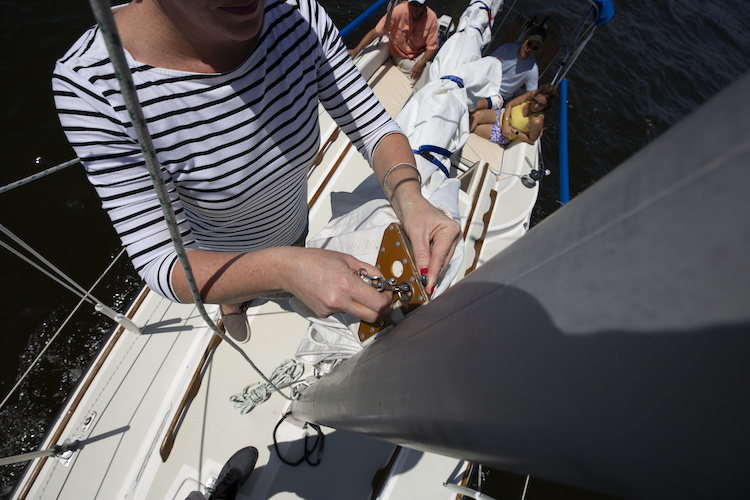
Knot tying is another useful skill for new sailors. Boats use lines for everything from controlling sails to securing equipment at the dock.
Start by learning a few practical knots, including the bowline, cleat hitch and figure-eight knot. You should also understand how to properly secure a line to a cleat and attach a line to a fender.
The good news is that knot tying doesn't require time on the water. Practice at home so you're comfortable with the basic knots before you need to use them on a boat.
Understand Sail Trim
Sail trim refers to adjusting the sails to make effective use of the wind. It's one of the most important sailing skills to develop and one that experienced sailors continue to refine.
As a general rule, sails are trimmed differently depending on the boat's direction relative to the wind.
When sailing upwind, sails are generally trimmed tighter and flatter. When sailing farther off the wind, such as on a broad reach, sails are generally eased and allowed to become fuller.
Sailors use telltales—small pieces of yarn attached to the sails—to help determine whether air is flowing smoothly across the sail. Watching the telltales and paying attention to how the boat feels can help you learn when to trim or ease the sails.
Learning sail trim takes practice. You'll gradually learn how small adjustments to the sails, steering and boat speed affect performance.
Learn to Tack and Gybe
Tacking and gybing are two fundamental maneuvers every new sailor should learn.
Tacking involves turning the bow of the boat through the wind. As the boat changes direction, the sails move from one side of the boat to the other.
Gybing involves turning the stern of the boat through the wind. Because the boom can move quickly during a gybe, beginners should learn the maneuver with an instructor and pay close attention to the position of the boom and other equipment.
Your instructor will teach you when to turn the boat, how to communicate with the crew and how to manage the sails during each maneuver.
Pay Attention to Wind Conditions
Sailing is all about learning to harness the wind, so understanding current conditions is essential.
Before heading out, check the weather forecast and understand the expected wind speed and direction. Beginners should practice in manageable conditions rather than attempting to learn in strong or unpredictable winds.
As you gain experience, you'll become better at recognizing how changes in wind direction and speed affect the boat.
Pay attention to what the water looks like, how the sails are behaving and how the boat responds. These observations are an important part of developing your sailing skills.
Know the Rules of the Road
Learning how to safely interact with other boats is an essential part of becoming a sailor.
The navigation rules establish responsibilities between vessels in different situations. You may hear the terms stand-on vessel and give-way vessel when discussing these rules.
However, having the right of way does not mean you should continue on course if doing so could result in a collision. All boaters share responsibility for avoiding collisions and operating safely.
New sailors should learn the navigation rules that apply to their boating area and follow the guidance of their instructor.
Learn more about Boating Etiquette
Practice Is the Best Way to Learn to Sail
Reading about sailing can give you a foundation, but spending time on the water is how you'll truly learn the basics of sailing.
Start with manageable conditions, practice with qualified instruction and focus on one skill at a time. As you become more comfortable, you'll learn to recognize changes in the wind, adjust your sails and respond to the boat's movement almost instinctively.
You don't need to master every sailing term or technique before getting started. Learn the fundamentals, practice your basic sailing tips and build your skills over time.
With the right instruction and experience, your first sailing lesson can be the beginning of a lifelong sailing journey.
Read Next: Beginner Sailing Tips
Q&A: Sailing Basics
Q: What are the basics of sailing?
A: The basics of sailing include understanding wind direction, points of sail, steering, sail trim, tacking, gybing, basic knots and boating safety. Beginners should also learn common sailing terminology and the rules for operating around other vessels.
Q: What are some basic sailing tips for beginners?
A: Some basic sailing tips include starting with professional instruction, practicing in manageable wind conditions, learning how to trim the sails, understanding points of sail and becoming familiar with basic boat terminology. Practicing regularly will help you build confidence and develop your sailing skills.
Q: What is the easiest way to learn to sail?
A: The easiest way to learn to sail is to take a beginner sailing course with a qualified instructor. Sailing schools can provide hands-on instruction in a controlled environment and teach essential skills such as steering, sail trim, tacking, gybing and boating safety.
Originally published in August 2019. Updated in October 2026.