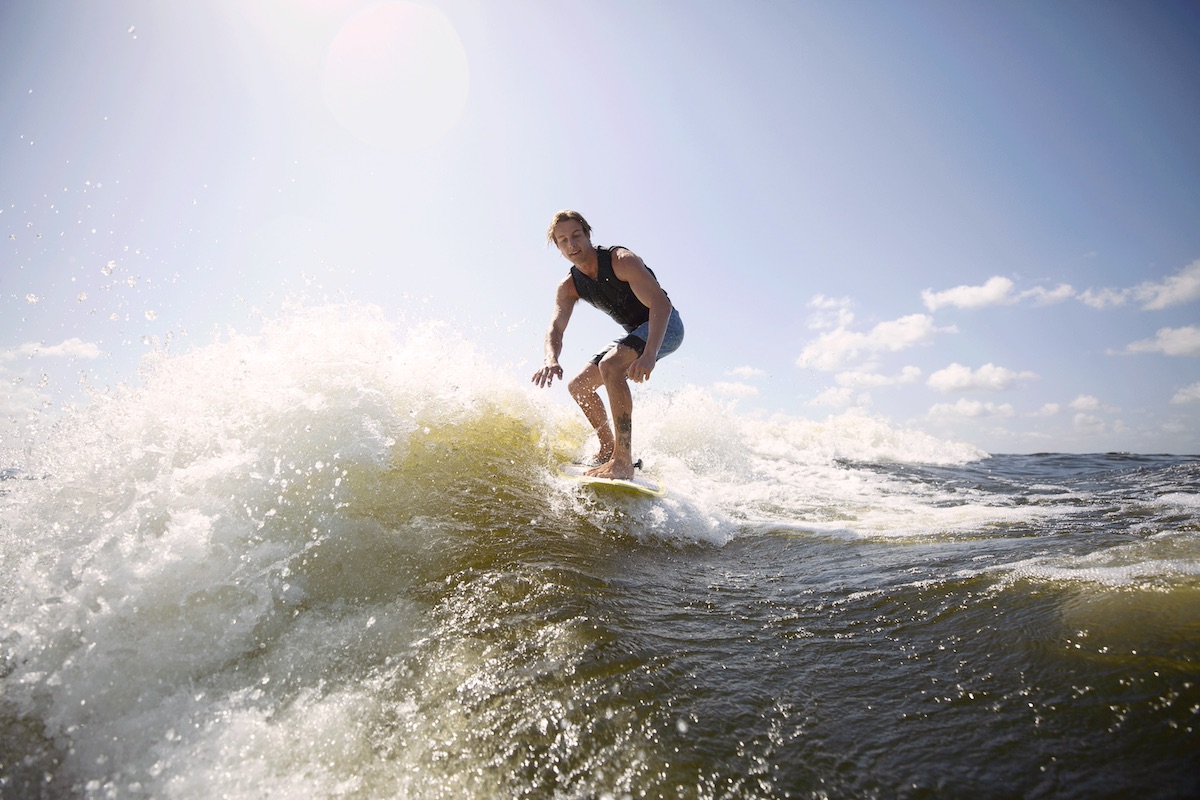
One of the greatest things about wakesurfing is that the wave is yours—all yours. You don’t need to battle with other surfers for territory or stake your claim to a wave by “dropping in first.” In wakesurfing, you own the wave for as long as you care to ride it—and as long as you #wakeresponsibly.

How to Wakesurf
- Find the right boat—generally a wake boat designed to throw out the biggest wakes.
- Choose the right board—beginner's boards are readily available in today's market.
- Get a wakesurf specific rope.
- Understand your boat's ballast system.
- Make sure your driver keeps the speed at around 10 MPH.
- Lay back in the water with your feet laying loosely on the board.
- Dig your heels into the wakesurf board and pop it up vertically.
- Keep your feet shoulder width apart, with your back foot anywhere from 6 to 18 inches from the tail of the board.
Explore Wake Boat Brands & Manufacturers
How to #WakeResponsibly
Learning how to wakesurf goes hand-in-hand with learning how to wake responsibly. To wake responsibly means that you’re not only having a good time on the water, but you’re doing so in a way that respects other boaters and local homeowners.
A little courtesy and respect can go a long way in keeping our waterways open and wake-friendly. Be sure to follow these three key pillars whenever you are wakesurfing:
1. Minimize repetitive passes.
We all seek the calm, protected shorelines and once we find it, we claim it as ours. However, repetitively driving back and forth in the same line can damage shores and docks. After a few passes you'll have churned up the water anyways. Take a break, move to another location and return later. Your spot will still be there when you return.
Remember, just as how we don’t appreciate when boaters and jet skiers get close to us when we’re riding, homeowners and other boaters don’t appreciate when we invade their space.

2. Keep music at a responsible level.
We realize that marine audio stereos are better and louder than ever before. Although water activities and cranking tunes go hand-in-hand, it’s important to be considerate of the time and situation, and of homeowners who might prefer peace and quiet—even if you are blasting our Ultimate Boating Playlist for your enjoyment.
Be particularly considerate in the morning and late evenings—the key is to be respectful, practice #CaptainsEtiquette, and #WakeResponsibly.
3. Stay 200 feet from shore.
Staying at least 200 feet away from docks and other structures allows boat wakes to dampen enough to minimize any adverse effects when they reach the shore. Not to mention, did you know that wakes and waves are optimized in deeper water? A where do we find deeper water? Towards the middle of the lake.
That’s why operating both at least 200 feet from shore and minimizing repetitive passes is a small step to ensuring that we can all enjoy our beautiful waterways.
Find the Right Boat
Wakesurfing really took off as an offshoot from wakeboarding. People started using wakeboarding boats for surfing, and then the tow boat industry took notice and began to tailor their lines to wakesurfing by cranking up the wakes to new heights. Why did wakesurfing become so popular so quickly? Because you’re less likely to get hurt while wakesurfing than you would if you were water skiing or wakeboarding.
The difference is that the speeds are much, much lower than skiing and wakeboarding and your feet aren’t attached to a wakesurfing board in bindings. When you fall, the board won’t catch under water and tweak the ligaments in your legs.
Tow boats have long been been known for having a wealth of electronics, towers, ballast tanks and wake-tuning systems onboard. The electronics are now primarily touch-screens that control the wake-tuning systems, and the modern stuff is really remarkable. You can store rider preferences and settings, such as ballast levels and tab angles, and make subtle changes based on conditions the day you’re riding.
With the advent of what's referred to as a Forward Drive, sterndrive manufacturers now offer wakesurfing models. The secret is the Forward Drive, which features dual, counterrotating propellers in front of the gearcase rather than in the rear, like traditional sterndrives. That keeps the propellers away from the rider, who is much closer to the boat in wakesurfing than skiing or ‘boarding.
Get the Right Gear

The Board: If you’re just starting in wakesurfing, seek out the “beginner boards.” There is a difference in wakesurfing boards and models geared toward more accomplished riders can be difficult for newbies to learn to ride. The differences are subtle in physical terms, but they are apparent in how they handle with a rider.
For more information, read How to Buy the Right Wakesurf Board.
The Rope: Rope choice is important, believe it or not, and of course a wakesurfing rope is different from a wakeboarding rope, which is different from a ski rope. Wakesurfing ropes are thicker and shorter, with a heavily padded handle. Some even have knots to help new riders pull themselves into the wave’s “sweet spot,” which we’ll explain later.
Life Jacket or PFD: You’ll need a personal flotation device, too. Modern PFDs look and feel more like down vests than the blocky foam pieces you might remember. Bright colors are helpful for spotting downed riders.
Let's Surf
Wakesurfing is more forgiving physically than skiing or wakeboarding, and it’s also not too difficult to learn, even a deep-water start. That makes it better suited to older riders such as baby boomers, who can still enjoy being behind a boat.
If you have some experience skiing or wakeboarding, obviously that helps, but getting up on a wakesurfing board is pretty straightforward. The flotation provided by the PFD is helpful. Begin by putting your heels on top of the board, with your back foot over the tail and your front foot at the middle of the board. They end up being about 18 inches apart. Point the forward end of the board toward the side of the boat you’re going to be surfing on.
Regular or Goofy

Left-foot forward riders will be comfortable on the port side. Right-foot forward riders go to starboard.
Getting Up
Now you’re ready for the driver to add throttle. As the boat begins to pull you, dig your heels into the board. There’s no rush to pull yourself up. Let the boat do the work to pull you up. Stand up slowly as the tail of the board digs in and starts to get on plane.
If you’ve never gone wakesurfing before, you’ll be surprised at how much push there is from the wave. Even with that push, it will take you some time for you to be able to drop the handle, and it all rests on your ability to find the sweet spot on the wave, usually just ahead of the “break.”
If your rider finds the wake too steep, add more ballast to the front. If the wake doesn’t have enough push, add ballast weight in the stern. Boat speeds will typically range from 10 to 14 MPH.
To turn, apply pressure to heel or toes, specifically your big toe. Be smooth about it. The board responds readily. To speed up, put more weight on your front foot. To slow down, add more weight to the rear foot. That’s enough to get you going. The rest is just practice.
Practice, Practice, Practice
The best part about wakesurfing is that practicing is fun, and taking a spill is far less punishing than any other watersport. Go riding with people who are better than you. In wakesurfing, you ride so close to the boat that you will be able to hear them give you pointers while you’re riding, and you can put them to use immediately. And there’s no rush whatsoever. That wave is yours for as long as you want to ride it.
Read Next: How to Get Up on a Wakeboard
You Might Also Like:
- How to Kneeboard
- Boat Tubing Basics
- Watersports Safety Guide
- How to Buy a Boat for Watersports
- Find the Right Boat for Your Lifestyle
Editor's Note: This article was originally published in July 2019 and updated in July 2020.