 What is a PWC?
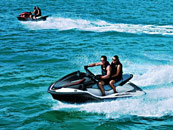
The official definition of a personal watercraft varies from state to state, but they are generally recognized as a vessel which uses an inboard motor powering a water jet pump as its primary source of motive power, and which is designed to be operated by a person sitting, standing, or kneeling on the vessel, rather than the conventional manner of sitting or standing in the vessel. PWCs are manufactured by BRP (Sea-Doo®), Honda (AquaTrax®), Kawasaki (JET SKI®), and Yamaha (WaveRunner®).
Who rides personal watercraft?
Many people are surprised to learn that 99 percent of all personal watercraft sold today are multi-passenger vessels, with three-seat models making up the vast majority of sales. These are family vessels, purchased by families who want to spend a day together on the water, and have found PWC to be affordable, approachable, and easy to store, transport, and maintain.
How many PWC are there?
The National Marine Manufacturers Association reports that 41,600 new PWCs were sold in the U.S. in 2010, with an average price of $11,123. The majority of all PWC sold today include new-technology 4-stroke engines. NMMA estimates that in 2010, there were approximately 1.3 million PWC in use in the U.S.
What about PWC emissions?
Some anti-access groups cite a study that compared an unregulated old-technology PWC with a regulated 1998 model car, which is an apples to oranges comparison. The fact is, with the introduction of "new-technology" engine improvements such as catalysts, direct injection, and four-strokes, marine engine manufacturers have achieved up to a 90 percent reduction in hydrocarbon and NOx emissions in a matter of years, as opposed to the decades it took the automobile industry to achieve the same reductions. New technology enabled PWC models to meet EPA’s marine engine standards years ahead of schedule; they are among the most environmentally friendly motorboats on the water today. All PWC manufacturers offer personal watercraft with four-stroke engines. Lake Tahoe-which has the strictest environmental requirements in the country-welcomes the use of more than 30 models of direct-injection and four-stroke personal watercraft because they are uniquely environmentally friendly.