Striped bass
Morone saxatilis
AKA: Atlantic striped bass, rockfish, stripers, linesiders, or pimpfish.
Distinguishing Markings:
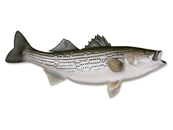
Striped bass is a silvery fish that gets its name from the seven or eight dark, continuous stripes along the side of its body. The body is compressed with dorsal fins well separated and a forked, olive green, blue, or black caudal fin.
Size:
Striped bass can grow as long as 60 inches.
Distribution:
On the Atlantic coast, striped bass range from St. Lawrence River, Canada to St. Johns River, Florida, although they are most prevalent from Maine to North Carolina. Striped bass tend to move north to near shore waters of the New England coast during the summer, and south to the North Carolina and Virginia Capes during the winter. Striped bass have also been successfully stocked in freshwater reservoirs and lakes
Habitat:
Striped bass inhabit coastal waters and are commonly found in bays but may enter rivers in the spring to spawn. Some populations are landlocked. They are anadromous fish that migrate between fresh and salt water.
Food:
Larvae feed on zoo plankton. Juveniles take in small shrimp and other crustaceans, annelid worms, and insects. Adults feed on a wide variety of fishes, crustaceans, squids, mussels, and worms.
Spawning:
Female striped bass can mature as early as age 4; however, it takes several years (age 8 or older) for spawning females to reach full productivity. Males can mature as early as age 2. Spawning is triggered by an increase in water temperature and generally occurs in spring or early summer. Once a mature female deposits her eggs, they are fertilized by milt ejected from a mature male. The fertilized eggs drift downstream with currents and eventually hatch into larvae within 2 to 3 days.
Bass Fishing Tips:
Striped bass are one of the most prized marine sport fish. Methods for taking them are legion and include everything from casting flies to trolling large “spoons” and other lures to fishing with complex “umbrella” rigs. A wide variety of fishing methods are successfully employed, including trolling, jigging, bait fishing, surf casting, fly fishing, and spinning. Baits and lures include mullet, squid, eels, crabs, clams, bloodworms, plugs, spoons, flies, and casting lures. For more information, read bass fishing tips written by professional bass fishermen.
If you’re new to saltwater fishing, or a seasoned angler looking for a new fishing boat, see our page on the best boats for saltwater fishing.