« back to main
Navigation, Electronics, Communication Equipment

Marine navigation and electronics are better than ever—and they keep advancing. With options ranging from practical—like GPS navigation systems and advanced boat instrumentation to satellite-based entertainment such as TV and radio, choosing can be daunting, even for experienced boaters. The upside is that there are excellent choices at every price point: the trick to making the right choice is in determining what features you really need and will use. Consider your boat, your budget and the type of boating you do; all will help you narrow down your options and choose gear that will meet your needs over the long haul.
Antennas receive broadcasted signals and transmit them to onboard devices such as VHF and AM/FM radios or GPS receivers. To work properly, VHF radios, GPS receivers and marine stereo receivers installed in cabins are often connected to remote antenna...
Electronic autopilots hold your boat on a preset course, and can follow a course determined by a GPS navigator, if it's linked to the autopilot. Self-steering vanes on large sailboats use mechanical gearing and a windvane to hold a course relative to...
Traditional brass instruments like barometers and clocks add a nautical touch to a boat’s cabin. Barometers measure atmosphric pressure and are used for traditional weather prediction.
A pair of marine binoculars is useful for locating marker buoys and other objects: Seven-power binoculars offer a good compromise between magnification and the ability to control what you see on a moving boat. Image stabilized binoculars let you see ...
A magnetic compass is a must for all but the smallest boat; you need one to find your way when out of sight of land or to follow a nautical chart. Electronic fluxgate compasses use sophisticated electronics to take readings, which can be eaily digiti...
Special software, designed to let you use a laptop computer to integrate and manage onboard navigation and communication equipment such as GPS, an autopilot and other instruments, is available. Electronic charts— digital versions of traditional paper...
Data loggers are electronic devices that record data for download into a computer; for example, a data logger will use GPS to record vessel movement, speed, and length of stops as a way to view and track its route.
Instrument systems display useful information such as speed, water depth, distance traveled, and on a sailboat, wind speed and direction on waterproof LCD screens. Modern instrument systems can display GPS and autopilot information, and track your c...
Electronic navigation devices that use the Global Positioning System are commonly called GPS receivers. They provide extremely accurate position location worldwide. GPS receivers are used in boats, cars, aircraft and handheld form by hikers and jogge...
Two-way VHF radios are the primary means for boaters to communicate short distances (3 to 25 miles) with other boats, harbormasters, bridge operators, towing services and the Coast Guard. Either portable handheld walkie-talkie style, or permanently i...
Onboard stereo equipment must be built to handle marine environments. Look for units made with water-resistant components, including conformally coated circuit boards, UV and corrosion resistance, seals around CD slots, and stainless steel parts. You...
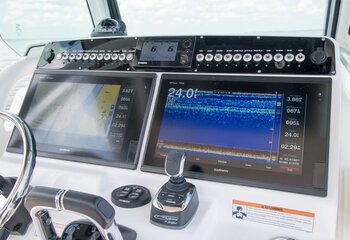
Electronic chart plotters use position location supplied by GPS and marine charts to deliver an easy-to-read picture of a boat's position relative to its surroundings. Systems vary from simple to complex; more sophisticated models can integrate infor...
Personal communciation devices keep you safe and connected when out on the water. Handheld VHF radios provide portable two-way communication (range of 3 to 8 miles). Satellite phones such as Iridium allow oceangoing mariners to make calls and communi...
Radar is a navigation aid that lets you “see” when you have no visibility because of fog, rain or darkness. A radar system works by emitting high-frequency radio impulses from a spinning antenna, measuring the time it takes for these impulses to boun...
Nautical charts (in either paper or digital form) are key navigational tools and the primary means for planning or charting a course and recording routes. Charts of U.S. waters are generated by NOAA (National Oceanographic & Atmospheric Agency), Cana...
Single sideband radio (marine shortwave radio similar to Ham radio) is the most common and affordable means of long distance communication on the high seas. Unlike a satellite phone, SSB allows you to communicate with groups of other boaters, or send...
Modern TV and audio systems make it possible for boaters to enjoy their favorite entertainment almost anywhere. Systems made for 12 volt DC electricity let you watch and/or listen to DVDs, TV and CDs even in remote harbors. Satellite TV antennas and ...
Barometers are traditional weather forcasting instruments that measure changes in atmospheric pressure to aid in weather forecasting. A wide variety of electronic weather monitors are also available; available features include the ability to monitor ...